Monday, 31 May 2010

The Deadly Design of Dachau


I walked through the wide open, rod-iron gate which read: Arbeit Macht Frei (“Work Will Set You Free”) and wandered through the dusty gravel to find myself in the middle of Dachau, the very first concentration camp, feeling a thousand different emotions. I was standing in the very place where thousands had stood before me, awaiting roll call, torture, and sometimes death. Dachau concentration camp is just one of thousands of concentration camps scattered around Europe, but it represents a history all its own, a very unique relationship with the nearby population, and such intricately planned buildings and objects.

I took a guided tour through Dachau Concentration Camp Memorial Site put on by a group called New Europe. If you have three hours to spend, I highly suggest the guided tour rather than the audio tour—because the personal stories made the tour more intimate and relatable. Before entering any of the buildings, we were briefed with a history of Dachau, located just 20 minutes outside of the city of Munich, where the National Socialist (Nazi) party began. What used to be an automotive factory was remodeled into a camp of political reeducation in 1933, only housing the Germans who opposed Nazi regime. Only after the Munich Agreement was signed in 1938 did Austrians become imprisoned here.

When World War II began, prisons got more crowded and due to poor living conditions prisoners were dying rapidly. Camps began to use forced labor and transitioned into extermination camps. It was at this time that other groups besides political adversaries were imprisoned. This included Soviet prisoners of war, homosexuals, Jehovah’s Witnesses, and because of Hitler’s fascination with the “Aryan Race”, Jewish people as well. Beginning in 1942, prisoners were made to work as slave laborers for armaments industries to support the war. Even the popular car company, Bavarian Motor Works (BMW), was known to have used prisoners for labor in their automotive factories during this period. Dachau was freed by the American troops in 1945, but had to contain the prisoners until they were free of disease to be released into the world again.

The history of the camp was captivating, but even more so was the extensive planning that went into every tiny detail of the camp. Walking into the camp, all you see is a sea of grey. Grey gravel. Grey rigid, boxy barracks. Grey torture cells. All of this was built in the Nazi-stlye architecture, a form of neoclassical architecture which was meant to convey a message of a timeless Nazi Empire that would last for all of time.

As our tour group took the path of the prisoners, we marched away from the illusory gate, which gave the impression that if a prisoner worked hard they would be set free—one of the many lies they were fed. We walked into the “welcoming building”, which was anything but welcoming. Here prisoners were stripped of everything that was their own—belongings, clothes, hair, name, dignity. In its place they were given a uniform with pockets they would be killed for using, made of the thinnest material and something unrecognizable for shoes, a tag to easily classify them, and a number—as if just one of many waiting in line on a Saturday morning at the bureau of motor vehicles. All of this occurred while staring at large print painted on the wall ahead stating, “No smoking”. A form of torture—reminding the prisoners they didn’t even have cigarettes to smoke.

Urban planning on a smaller scale was witnessed on our tour of the barracks. Although only two remain still standing, that was enough to stain my memory for a lifetime. There were different barracks to represent the different stages of Dachau and the need to fit more people in the already claustrophobic space. The original beds were stacked three beds high but contained dividers and shelves. The dividers gave each prisoner their own bed, no matter how small it was. The shelves were a subtle hint planned to constantly remind the prisoners that they didn’t have any possessions to even place on a shelf. Similar to crowding in big cities, crowding in concentration camps resulted in a loss of personal space, thus a loss in the dividers between beds. This small change almost tripled the number of people that could be contained. I was suffocating at the thought of how horribly one human could ever possibly treat another when we walked into the gas chamber/crematorium, chillingly deemed “Barrack X”. Just one more example of the deceitful scheming of the Nazi’s who labeled it the shower to fool prisoners. Because Dachau was the first concentration camp it was used as a model for the rest of them, this being the trial and original crematorium. Prisoners living in the camp when it was freed would not allow for its destruction so it could serve as a reminder to future generations.

Since the camp has been freed, many architectural changes have been implemented—the first being a series of religious churches and chapels of reconciliation. The one that stands out the most is the Protestant Church which has no square edges at all—exactly opposite of Nazi architecture. Among the many monuments one stands out above the rest. It is a statue of a prisoner with his head held high, hands in his pockets, wearing real clothes. Underneath it says “We honor the dead, to warn the living.” Not only does Dachau’s history serve as a reminder to the local community of Munich, and not even just the German people. Although locals may observe the history in a different light than a survivor, or an outsider like me, this monument is a reminder to all that genocide is not the answer to any problem. I left back through the same open gate, which is never allowed to close again, luckier than a lot of people who once entered it. I left shocked at the cruelty of humanity, sadness for the events that happened there, but with a wealth of knowledge and thankfulness to be who I am and where I am today, with the power to change genocide that still affect the world today.

Where are the Park Rangers?

After and extremely long and exhausting train ride from Prague to Munich, I was finally ready to experience Germany for the first time. Traveling with my good friend Dave and new friend Brian, we didn’t arrive into Munich until about 10:30 Friday night. It has been said that first impressions are everything, but Munich showed me this is not always the case. After getting out of the train station, I found myself feeling the opposite way I did in Amsterdam; I was surprised at how FEW people were walking the streets. Once we checked into our beautiful yet pricey “Hotel Adria” we decided to take a stroll around the central square to find some drinks. One would think in a city with about 1,300,000 people it wouldn’t be hard to find a standard bar open on a Friday night, but this wasn’t the case. The only bars which seemed to be open were bars with all glass windows and candle lit tables, packed with 25-35 year old business professionals. We all agreed those places were not our “scene” and called it a night. At this point I couldn’t help but think how my experience in Prague would completely overshadow Munich, but I was wrong.

Before sleeping on Friday night, I decided to do a little research about the places to go and sights to see. Like most large European cities, a river (the Isar River) flows directly through the urban area which once allowed for easy transportation and trade. This river branches off in many places throughout the city, causing many creeks to run along and underneath roads and sidewalks, leaving countless striking scenes. Again like many old European cities, Munich was once a small town enclosed by a wall, but eventually tore down the wall due to population increases in order to expand further out in Germany. With this expansion came the beautiful and lush green parks, also known as “beer gardens”. Brian, Dave, and I all agreed we had to see these gardens because they are in a huge European city where you will rarely see any green grass within city limits.

http://www.discover-munich.info/about_munich.php

After a hardy breakfast of frosted flakes, coffee and a beautifully bright orange-ish pastel colored peach on Saturday, we were ready to experience my favorite part of the weekend: the beer gardens! As we were making our way onto the giant open lush green grass fields, I couldn’t help but notice something a little different from a park in America; there were naked men lying out under the bright sun everywhere! We all shared a few chuckles realizing this was a simple cultural difference between Europe and America, but it was one that I was not quite prepared for! Seeing naked men all around made me wonder why these gardens were created instead of creating residential areas or industrial areas. I later found out from a Munich tour guide these gardens were created for military soldiers to pursue normal civilian activities like gardening in the 18th and 19th centuries. Walking on the bright green grass made me notice how there was virtually no trash anywhere to be found on the ground. To even more of my amazement, trashcans also seemed nowhere to be found (Another cultural difference from America).

Finally we all made it to our desired destination: the Englischer garden. In this garden live music was playing with a large sized building which sold everything from huge beer steins to seemingly every cooked animal you could imagine (and of course many sausages!). Wonderfully large trees shaded the sun from reaching our backs while sitting on the benches, which made this beer garden visit especially tranquil. After we finished our steins, it was time to head to the rumored fan-favorite beer garden in Munich: the Seehaus beer garden. In about a five minute walk, we came upon a large picturesque pond filled with mallard ducks, swans, and many other birds. The Seehaus garden was located directly on this large pond, with the benches and tables no more than a foot away from the water! We all bought another round of steins, this time to my dislike, a very sweet tasting beer. Fortunately the surroundings around me made my girly beer still taste like heaven :)
The beer gardens were the most soothing and relaxing experience I have had since arriving in Europe, and It completely changed my perception about Munich as a European city! If anyone is to ever ask me about Munich in the future, the first thing I will tell them is about the beer gardens. Even though Munich is a city with wonderful architecture, it was the beer gardens which distinguished this city from all other European cities I have seen so far on this trip.

Nationalism in Germany at its Finest


Nationalism can simply be defined as an extreme form of patriotic feeling. In class, we have greatly emphasized this topic, with special importance on European nationalism. It is evident that the politics of Europe are around us each and every day. However, politics are more than about differences, but about meanings and belief systems such as ideas, social practices, and spatial expressions. This can be cumulatively referred to as culture. The culture that is unique to various individuals and territories can have material consequences. One culture that is of particular importance in Europe is that in Germany. This weekend, we traveled to Munich for two days and saw some inspiring sites.

At 7:30am the six of us rolled out of our overnight train out into the buzzing Munich train station. We grabbed a quick breakfast and checked into our hostel right across the street. This hostel has definitely been the nicest one that we have stayed in, by far. We were expecting it to be deserted with people at 8:00am, but it was just the opposite. There were probably 30 backpackers in the lobby waiting to check in. With all of the cultural diversities we have experienced in Europe so far, I have to admit that this atmosphere was comforting. Being able to check into our clean room, while speaking to the hostel workers in English, made it a great start to the day.

We decided the best way to begin exploring Munich would be to take a free walking tour of the city. We arrived at the designated meeting area and divided into smaller groups. This made the tour more interesting, as well as less impersonal. Our tour guide was a young, lively, interactive, Texan native named Kevin. At each site we stopped at during the whole four hours was filled with factual information that was presented in an entertaining way so that he was not simply lecturing us. I really do believe that the personality and enthusiasm that these guides bring to tourists like us really have a significant impact on our impressions of the city.

As we walked from monuments, to churches, to plazas, to other significant landmarks, it was clear that Kevin was passionate about his country. Not only was Kevin enthused to share his knowledge with us, but was also eager for us to have even just a glimpse into his German culture. His sense of patriotism, or nationalism, was that of the utmost loyalty and appreciation for this country. When he paused to talk about Kristallnacht, Kevin seemed to get choked up. This event, in November of 1938, is known as “the spark that ignited the Holocaust”, or “Night of Broken Glass”. November 9th and 10th of 1938, the Nazis staged the destruction of hundreds of Jewish owned or associated buildings. This night began the Nazi tyranny against the Jews: the Holocaust. Millions of innocent people were forced to live in horrible conditions, work for hours on end, and many were murdered. This website from the United States Holocaust Memorial Museum offers supplementary information regarding this anti-Jewish movement.

http://www.ushmm.org/museum/exhibit/focus/kristallnacht/

When Kevin finished our tour, he said, “If there’s one thing I want all of you to remember, it is that us, as Germans, are not proud of the events that took place in the 1930s. However, we are aware that these events did happen and do not want to cover it up and pretend that it is of no importance. We can use this history to demonstrate that the Nazis were not monsters. They were human beings. We are all human beings. The Holocaust can be used as a symbol of what mankind is capable of. We have monuments across the city of Munich to remind us of this, and to make sure that nothing like this will ever happen again.” These sincere words touched each of us on Kevin’s tour.

The next day, the six of us were inspired to visit the Dachau concentration camp. This camp was set up in 1933 as a “school of violence” and a model for further concentration camps. Ironically, the gate reads “Arbeit Macht Frei” or “Work will Set you Free”. From the moment we walked inside, until we took the train back to Munich, the atmosphere was solemn. I am certain that each of us were merely attempting to encompass the horrifying events that took place under our own feet. Even with the blue skies and warm weather, the environment was anything but pleasant. After visiting Dachau, many aspects clearly coincided with class material. One article we read, in particular, focused on landscapes and how tangible monuments hold historical meanings and important of past events. This memorial site holds a significant meaning to those who are knowledgeable about the Holocaust and are devastated by the outcome. Dachau remains as a reminder to all who set foot on site that this terrorism of the Jewish population was real and had real consequences. One monument, in particular, consisted of corpses that were intertwined to resemble an electric fence. This architecture combines both the fence that enclosed the territory of the concentration camp, as well as the deadly nature of the Jewish extermination. This tour of Dachau paralleled to Kevin’s statement about not dismissing that the Holocaust existed, but acknowledging the capability of human beings as mass murderers. More information on this concentration camp can be found at the website of the Jewish Virtual Library.

http://www.jewishvirtuallibrary.org/jsource/Holocaust/dachau.html

"Work sets you free"


“Arbeit Macht Frei” or “Work sets you free.” These are the words that the prisoners saw as they entered Dachau Camp. These words encouraged the prisoners that if you work hard enough, the Nazis will release you. Little did they know that the phrase was strategically placed there to mentally and emotionally torture. Dachau was the first concentration camp and it was the only one to span the entire reign of the Third Reich. It is located about 16 km from Munich or in my case, about a 15-minute train ride. After my tour, I learned all about Dachau’s historical and political importance to Germany.

Dachau was originally an ammunition factory during World War I and it provided lots of jobs to the local German people. The ammunition factory was closed as a result of the Treaty of Versailles and consequently many people lost their jobs. In 1933, the National Socialist Party, the Nazis, established Dachau as the first concentration camp. During Dachau’s first stage, people were interned for political opposition to the Nazis. The model of the building that I saw was not built to holdthe shear numbers of the people that were detained and tortured there. Each stage of was marked on the tour with a different room. The first room showed the initial number and set-up of the barracks.

The second stage included racial discrimination and increased amounts of terror at the camps. My tour guide made an interesting distinction between prison and concentration camp. “A prison is usually of citizens of that country, people who have rights in the country, where a concentration camp, all of its detainees are striped of all their clothes, hair, and basic human rights.”

The third room the tour guide, Marcin, took us to was the final stage of the construction of the Dachau barracks. Basically just rows on rows of bunk beads. This time, there was no distinction between beds nor the people that slept in them. This was designed so that more people would fit in each bed and the Nazis found any reason they wanted to put a person in the camp. It was sickening to think about the number of people that were in each bed. It is even more tragic to think about the living conditions of the people that lived in these beds.

My least favorite part of the tour was when we walked to Barrack X. It was disturbing because that was the site of the gas chamber and crematorium. It was so eerie walking through the building where mass murders of innocent people occurred. The first room in the gas chamber building was the “waiting room” where the people awaited what they were told was “showers.” The next room was the shower room and the Nazis had placed showerheads in this room to continue the psychological torture. The next room was the crematorium where all the dead bodies were burned after they were gassed in the "showers."

Dachau was not the only camp to have these conditions and terrors. I took the picture below from the museum on site because it is a map that shows the number, size, and location of the other concentration and extermination camps. An interesting point about the map is that there are no boarders. The camps were all over Europe because of Germany’s and the Nazi’s strength and aggression and therefore boarders are invisible. The horror of the Nazis witnessed no boarders.


It was so difficult to walk around on those grounds and just imagine all the people who had lived there and those who died at the hands of the SS guards. Needless to say it was a quiet evening for me because I was trying to understand and come to terms with what I had witnessed that day. I know that it was hard for me to deal with what I saw and learned but it is impressive to see how the Germans have come to terms with it and accept it as part of their history. In 1945, the US Army liberated the people of Dachau. Since then, the camp serves as a reminder to the Germans to, “ Honor the dead to warn the living” (written on statue below). The Germans built this memorial of the former concentration camp in order to do just that, honor the people who died at Dachau, in order to warn the living that this should never happen again.

This experience was a very meaningful one for me and it is something that I will remember for the rest of my life. I recommend the tour with NewEurope because it included transportation and the tour guides are very knowledgeable. It was a lengthy, paid tour but I would do it over in a heartbeat because I know that I learned a lot of important historical information. There are many accounts and information about life at Dachau or the brutality of the SS guards and information can be found at the Dachau site.

The Dangers of Extreme Nationalism

Walking down the cold, narrow cement surface, I looked to my right and peered within the four walls of a tiny room inside the bunker. I began reading the description on the dark and weathered wall, but was disrupted by a tour guide stopping behind me and beginning his explanation to the other foreign tourists. I listened as the words began echoing quietly, but sternly from his mouth. “These rooms were constructed for torture. When the prisoners acted out, or if they allegedly broke the rules, this is where the Nazis would take them. They would separate this tiny room into fours, preventing the prisoners from sitting down. Yes, they had to stand here for days, in complete darkness and endure physical acts of brutality for merely being a Jew. After weeks of enduring physical brutality, they were given a blunt knife and a piece of rope, and were told to kill themselves by morning. If they refused, the torture would start all over again…” the guide began to move forward but I was struck with a sense of shock, and surprisingly I felt a tear fall down my cheeks. So this was Dachau.

Dachau was the first Nazi concentration camp opened in Germany in March of 1933 (http://www.jewishvirtuallibrary.org/jsource/Holocaust/dachau.html). I never imagined the morbidity of the camp on the 10 mile trip from Munich on the first buzzing subway that gave me butterflies when rapidly crawling through the tunnels, or on the touristy bus ride through a small neighborhood. I was filled with a sense of anxiousness and excitement upon entering the camp. Over the years Nazi Germany has continuously been talked about in school, whether reading about it in novels, listening to speakers, or seeing pictures in textbooks, I was in slight disbelief that I was actually going to visit one. However, as I stepped off the bus onto the gravel walkway, it was apparent the seriousness and reverence that was written on the visitors’ facial expressions. As I walked down the tree-lined road towards the camp, a chilling wind caused my own arm hairs to rise. Silence was unanimous as I walked through the gates and into Dachau.

As I began my excursion of the camp, I could not help but try to in vision myself as a prisoner of Dachau based on my religion or ethnicity. A person’s sense of place occurs from cultural artifacts that identify themselves in terms of their beliefs and ways of living. Religion is something that is prevalent and defining in most people’s lives, and was a crucial determinant of the lives of Jewish people in the mid-20th century. Jewish people in Germany were persecuted from 1933 to 1445 under the Third Reich, and Dachau especially sponsored killing, which by the end of the war was responsible for the capturing of 206,206 prisoners and at least 31,951 deaths of innocent lives (http://www.ushmm.org/wlc/en/article.php?ModuleId=10005214). As I walked through the museum and observed the main halls, I read about the medical experiments that scientists conducted on prisoners. As a chill ran up my back, it dawned on me that Dachau was a lawless community run by the hatred and detestation of a certain religious group or any individual who was anti-German, or anti-Hitler. Within the walls, or boundaries of Dachau, the coalition of the National Socialist Party had the ability to fate any prisoner who was ceased and brought within the camp gates. German nationalism during World War II became fanatic, violent, and militant. Nationalism is usually associated with pride and adherence, the waving of flags, the pledging of allegiance. No one ever conceives that a strong and devout sense of nationalism will lead to experimentation, alienation, torture, and extermination.

Yet, as I roamed the narrow wooden halls of the barracks, I saw the beds crammed together, nearly touching the ceiling, and realized how dangerous a pious sense of nationalism can be. I was alarmed on how spacious the actual camp was, and was astonished to learn the camp had been divided by the camp area which consisted of 32 barracks, and a crematorium used to dispose of the numerous lifeless bodies there were merely numbers to the Nazi soldiers. Nationalism at is most extreme classified a group of people either by religious connotations or an opposition to the Nazi regime, and held them together by en electrified barbed-wire gate, a ditch, and a wall with seven guard towers, manipulating this instituted boundary for excessive violence.

Artistic Expression & Separation

In August of 1961, the GDR (German Democratic Republic) completely closed off East Berlin from West Berlin by erecting what is today known as the Iron Curtain. The Iron Curtain doesn’t entirely refer to the Berlin wall, but more broadly refers to the separation of Eastern and Western Europe. This 103 mile-long concrete barrier had East Berliners trapped u

nder Communist rule for nearly a qua

rter of a century (http://www.dailysoft.com/ berlinwall/maps/berlinwallmap_02.htm). After years of constant struggle, world tensions and divided territory, the wall finally came down in November of 1989. This major event in world history was broadcast all over the world and symbolized the beginnings of a more unified democratic Europe.

Today, when you visit Berlin there is a distinct presence

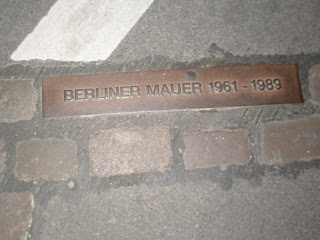
associated with that dark time in recent history. When you walk down both main and back streets, you find plaques, fragments, and large spans of the wall that remain. One can begin to get a sense of how expansive and controlling this wall was. Just crossing the street there is a brick line that represents where the wall once stood. Reminders of the wall also exist next to major buildings, such as the Reichtag

and Brandenburg Gate, major tourists attractions of the city. It is interesting to see how the urban landscape has developed and merged over this once clearly divided city. New shops, offices, and streets are interspersed along the former path of the wall.

Most impressive, however, is the East Side Gallery. It is the largest stretch of wall that is currently intact stretching 1.8 miles parallel to the Spree River. This gallery consists of expressive, bold art that has been created from artists all over the world to visually voice about the affects of the wall and how it is

not something to soon forget (http://www.dailys oft.com/berlinwall/guide/east-side-gallery.htm). This artistic movement began in the 1980’s and still continues today. Unfortunately, many of these pieces were neglected, painted over, and ruined during the 1990s. Some of the more famous works were repainted thanks to donations and private sponsors for the East Side Gallery. I saw long spans of wall that were taken over by tourists signing their name and writing messages about the wall. Although the wall is ‘protected’, it still needs more care.

The effects of the Iron Curtain are seen all over the wall itself and the city. The West side of the wall is covered with the artistic murals which represent the unification of Europe after the wall was torn down and the East side is painted a plain grey to represent the plain, controlled lives that were existent in Eastern Berlin as well as Europe. This deep symbolism is not only graphically moving, but g

roundbreaking because this infamous site is not your typical historical monument of a churc

h, sculpture or museum rather it’s an artistic expression that is constantly changing and reminding others of the impact separation and world conflict brings.


*An interesting view of before and after pictures of Berlin can be seen in this article. Notice the buildings that have remained and the ones that have been replaced in the street facades: http://www.nytimes.com/interactive/2009/11/09/world/europe/20091109-berlinwallthennow.html

Sunday Morning in Munich

Sunday morning, after leaving my hostel in Munich, Germany, we ventured into the town square. The official name is Marienplatz, or St. Mary’s Square. It was renamed after the Virgin Mary to protect the city from disease. As you can see from this map (http://www.munich-info.de/images/karte151.gif), the Marienplatz is located in the center of the city.

The Marienplatz has been prominent ever since the city was founded in 1158. It used to be the central location for selling salt and grain. I was previously unaware, but Germany is actually home to several salt mines. They have been in operation since the early 1500’s and there are still several around today. With the Marienplatz being so close to the Isar River, trade and transportation of Germany’s products by river was common.


Today, the Marienplatz offers much more than salt and grain. It is a prominent location among both locals and tourist. There are several remarkable and mundane structures and vendors that make up and surround the Marienplatz. As I wandered around the square, it wasn’t so much the souvenir stands and stores that enticed me, but rather the people. With it being a Sunday , I was under the impression I was surrounded mostly by locals or residents of Germany. Church-goers flooded into the streets as church bells chimed. I felt a bit underdressed in my jeans and Northface, as I was surrounded by people in more formal attire. Tiny old ladies in pencil skirts and heels leisurely made their way through the cobblestone streets chatting in Deutsch.


Several young children were also dressed in their Sunday best. One thing that struck me was seeing families of multiple generations. On several occasions, I would see a couple with children and one or two grandparents. Also, I would rarely see a family with more than two kids. This is reflective of the European trends in terms of aging, population and fertility. Europe is experiencing an increase in population, but decrease in fertility. These statistics show the age distribution in Munich. There is a considerable difference in the number of aging adults versus children.

Age 0 - 5
Proprtion in % 5.3
Age
6 - 14
Proprtion in % 6.9
Age 15- 44
Proprtion in %44.6
Age 45- 64
Proprtion in % 25.7
Age:
over 65
Proprtion in %17.5


Source: Munich Statistical Office (Statistisches Amt der Landeshauptstadt München).


Several locals were also lounging outside cafes drinking coffee, eating pastries, and admiring the Glockenspiel, which is attached to the prominent, gothic-style town hall. Each performance consists of music and life-sized wooden figures depicting the wedding of Duke William V and Renata von Lothring, a joust and doing the Cooper’s Dance.
This was first done by barrel makers in celebration of the end of the Black Plague. The noon performance of the Glockenspiel was a big tourist attraction. The tourists were pretty easy to spot with their cameras out. The history was interesting, but overall I think it was overhyped. Tourists began to disperse long before the ten minute act was over. While they were rushing off to their next stop on their travels, the locals remained. Aside from the dress code, it was evident who was and was not a tourist. Most of the locals were surrounded by family or friends and moved at a much slower pace.